
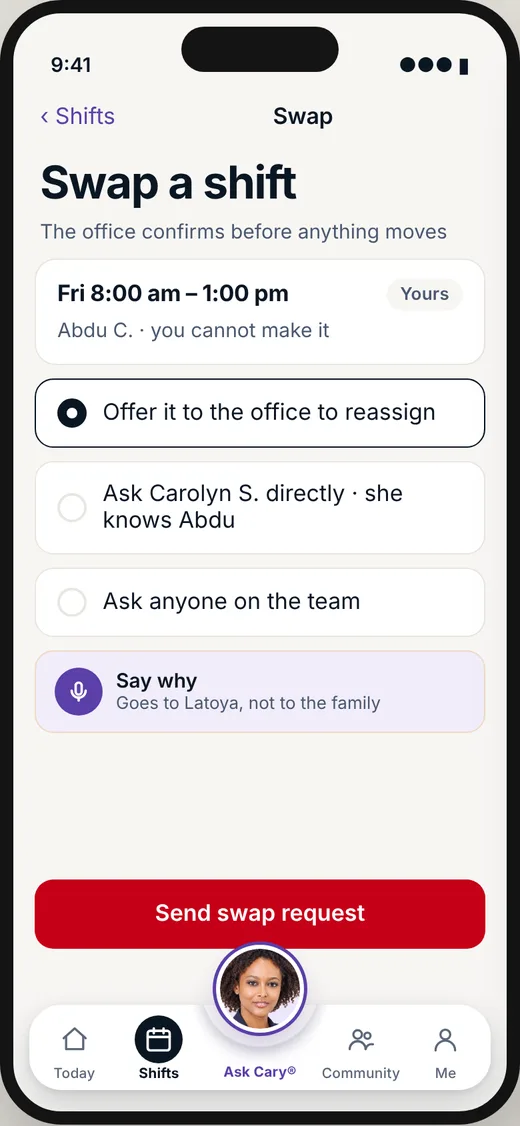
Caregiver
Agent 01 of nine · Scheduling & Payroll · The callout you didn’t have to cover.
CareBravo®’s Scheduling agent is AI scheduling and payroll software for Medicaid home and community based care agencies. The caregiver’s tap at the door is the timesheet. A person confirms anything that moves money or changes care.
The work we carry
The callout filled, hours verified, payroll reconciled.
The bravo you keep
You weren’t up at 5am.
We email you the highlights the moment you ask. No call. Nobody calls unless you ask.

The product, not a promise
Real product screen. Sample agency, sample data, not a claim.
Caregiver
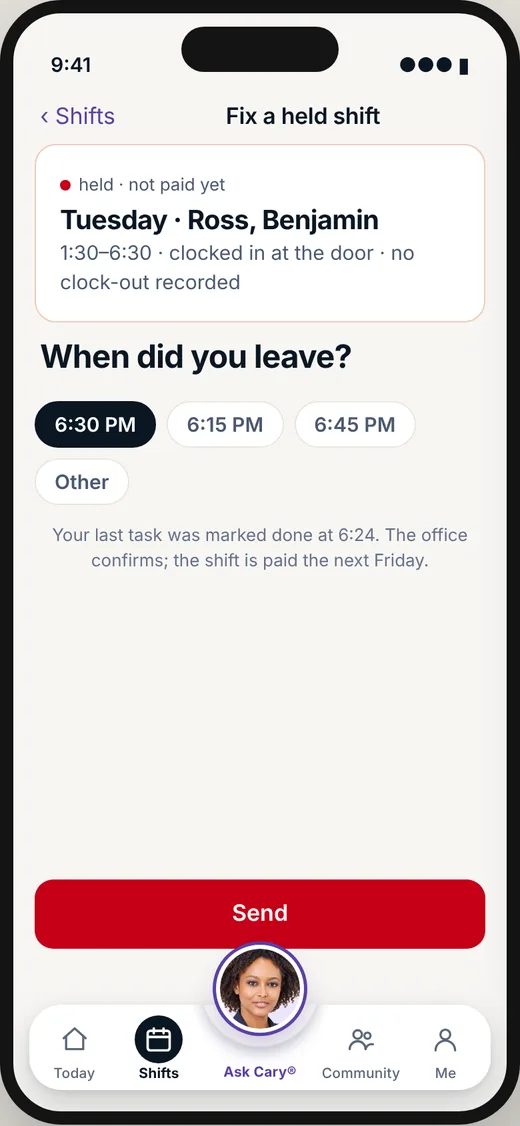
Caregiver
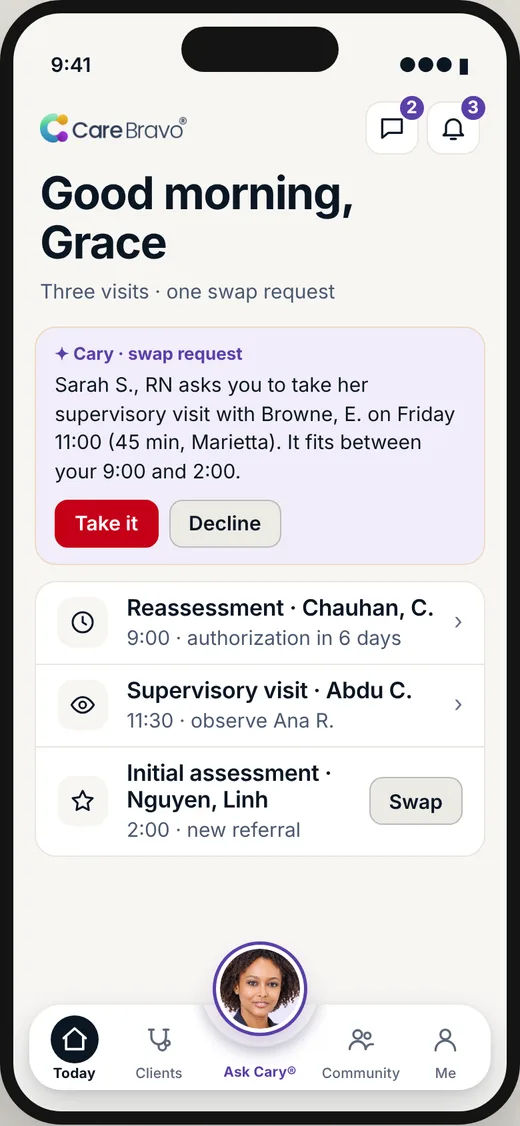
Nurse
Real product screens. Sample agency, sample data.

On the office screen: The scheduling desk: call-outs, open shifts and who is covering, on one screen.
Why your current app can’t
Your scheduling app shows the open shift. It does not fill it. At 5am that is you, the phone tree, and whoever answers first. Then the hours she worked get typed into payroll by hand, and the two never quite match, so Friday brings the question: why is my check short?
What the Scheduling agent makes from the tap
The caregiver’s tap at the door is the timesheet. The payroll file is made from it, so the check matches the shift. When someone calls out, the Scheduling agent offers the shift under the rule you wrote once, to caregivers who asked for more hours, and the office confirms. You find out at breakfast.
CareBravo is the Autonomous Care OS®: an operating system for Medicaid home and community based care, with an AI agent built into each of nine jobs. It starts as the EVV your state approved. Then it does the office work from the caregiver’s one tap at the door. How the whole thing works
An owner’s exact words, answered on the screen, three ways to have it done.
Owner asks
Your scheduler opens the scheduling desk, sees the swap request with the facts, and confirms who takes the shift.
The office confirms before anything moves.Cary offers it to caregivers who know the client and are inside their hours, in the order of the standing rule you wrote once. You see it covered.
Covered, under a rule you wrote once.Managed Scheduling, field scheduling carried by our team, is available by conversation.
Owner asks
Payroll is built from timesheets, not claims. Your office reads what is not payable, approves, and exports in your payroll company’s format.
A person approves it.Cary builds the payroll draft the night before pay day and shows what is not payable and why. A person approves it.
Friday night went home.Yes. Several home care systems now use AI for scheduling and payroll, mostly in scheduling and billing, and in most of them the AI suggests while your office does the work. In CareBravo, the Scheduling agent does the work inside rules you write once: The caregiver’s tap at the door is the timesheet. It is one of nine agents, one for every job in the office, coordinated by Cary. A person confirms anything that moves money or changes care. CareBravo’s AI runs inside our HIPAA safeguards. Your clients’ records are not sent to public frontier AI models.
Rates are applied by role and shift, with overtime at 1.5x over 40 hours, holiday rates, and travel time between back-to-back clients. Your office sets the rules; nothing is paid until a person approves the run.
It is a platform on every plan. On Core your scheduler works it with full visibility. On Autonomous, Cary and the agents run the routine inside your rules and you decide the exceptions. Managed Scheduling, carried by our team, is available by conversation.
Anything that changes money or care waits for you. There is no setting that removes the confirm.
Authorized hours are what the state or plan approved for the client. Scheduled hours are what you put on the calendar. You can only bill up to the authorized amount, so schedule inside it. CMS lists billing more units than the plan allows as a common error that leads to improper payment. Read the full answer
Let caregivers swap only with someone trained and cleared for that client, and have a person in your office approve it before the visit. Georgia’s private home care rule says no personal care assistant may be assigned a task before required training and a competency check are done. Update the schedule so the visit record matches who really went. Read the full answer
In CCSP and SOURCE, a care coordinator does the assessment, builds the care plan, and puts the hours on a Service Authorization Form. A doctor, or the case management agency’s medical director, approves the plan. Your agency does not write the plan. You deliver the hours that are authorized. Read the full answer
In Georgia EVV, a provider administrator can update the visit by hand and pick a reason code from the list. Use the start and end times the caregiver reports. DCH says manual schedule changes are for fixing errors like a missed clock-in, not for lowering billed units. Read the full answer
Work down a call list in order: the client’s other caregivers, then staff who want extra hours, then your supervisor. If nobody can cover, tell the client early. Georgia’s private home care rule says that in an unexpected shortage you must advise the client and refer them to another agency if they want one. Read the full answer
You take the bravo. We take the work.
The Calculator maps your drain across all nine jobs, shows which to hand over first, and recommends one plan. It never sells you up.
We email you the highlights the moment you ask. No call. Nobody calls unless you ask.