
The nine jobs
Nine jobs pulled you off the floor. Nine agents take them back.
CareBravo® covers the nine jobs behind a Medicaid home care agency, each with its own AI agent: scheduling and payroll, compliance and EVV, billing, communication, documentation, referrals and reputation, hiring, retention and training. Each agent is judged on one outcome, and a person confirms anything that moves money or changes care.
Running a Medicaid agency means doing nine jobs nobody told you about. On the Autonomous Care OS®, each job has its own AI agent, and each agent is judged on one outcome written on its own screen. You confirm anything that touches money or care.
We email you the highlights the moment you ask. No call. Nobody calls unless you ask.

Real product screen. Sample agency, sample data.
Pick the job that costs you the most sleep.
Community is the room beside the nine jobs, not a tenth job. It is included in every plan.
Why this works
One tap at the door should run the whole agency.
In CareBravo, the caregiver’s tap at the door and her one voice note at the end of the shift are the only things anyone types. The timesheet, the paycheck, the claim, the chart line and the family’s update are all made from them.
Nothing is retyped, so nothing drifts. If the tap is missing, the caregiver is asked one question and the office confirms the time. If the state rejects a record, it comes back explained in plain words and goes back in tonight’s batch after your Go ahead. The nurse signs the chart. That is the whole trick. It is why denials stop, why payroll is right on Friday, and why the family never has to call.
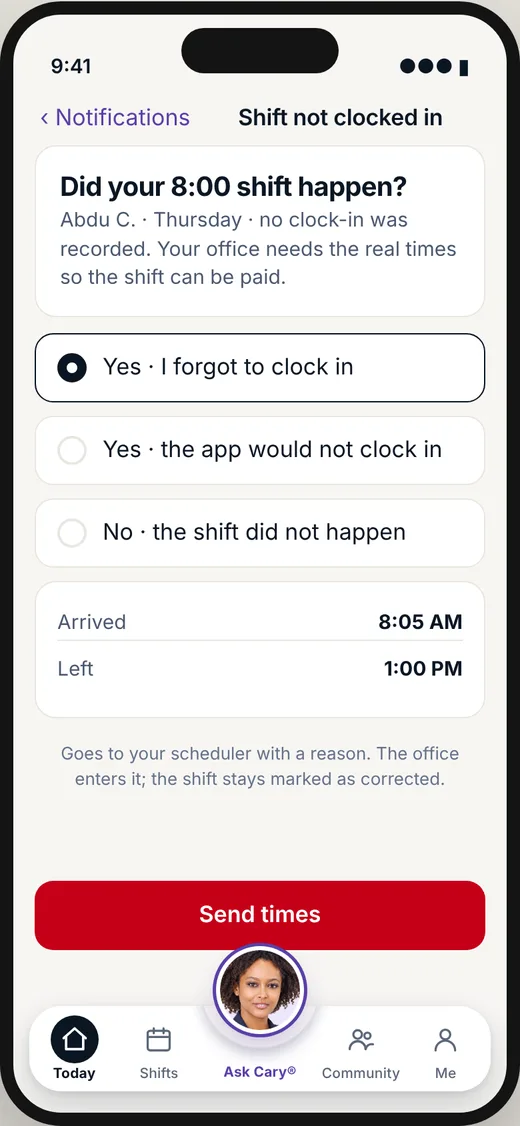
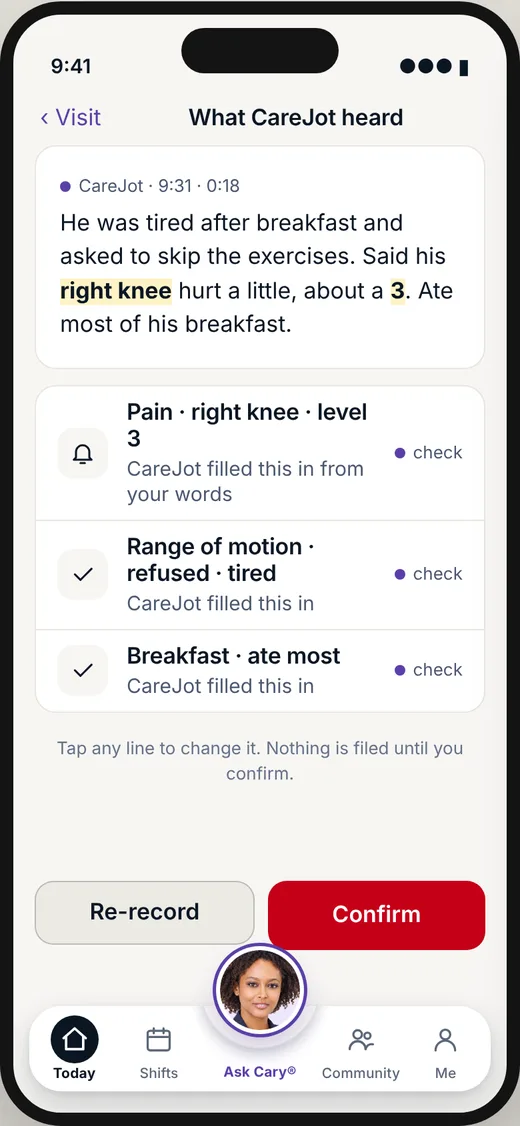
Real product screens. Sample agency, sample data.
Five promises, written like promises.
- Nothing stops. Your current system keeps running while CareBravo runs beside it for two weeks on your real data. The Parallel Promise™
- 99%, in writing. On Managed Billing, at least 99% of your claims go out without a mistake we caused. If we make one, we fix it free. We cannot promise what a payer decides. Read the guarantee
- The floor, stated up front: $250 a month, no seats, no per-user fees, no implementation fee — and corrections never billed twice.
- Thirty days’ notice, either way.
- Nobody calls unless you ask.
Questions owners ask.
What is the difference between authorized hours and scheduled hours?
Authorized hours are what the state or plan approved for the client. Scheduled hours are what you put on the calendar. You can only bill up to the authorized amount, so schedule inside it. CMS lists billing more units than the plan allows as a common error that leads to improper payment. Read the full answer
Why was my claim denied for units or authorization?
Medicaid pays only for the units and dates that were authorized. If your claim has more units than the authorization allows, falls outside its dates, or lists a different provider ID, it denies. In Georgia these show as codes like 3052, 3011 and 3044. Prior authorization alone does not guarantee payment. Read the full answer
How do I keep families updated without calling them all day?
Pick one way to update each family and tell them at intake. Send one short note after each visit. Call right away when something changes, like a late caregiver, a missed visit or a fall. Ask the client who may get updates, and write the answer down. Read the full answer
What should be in a client file and a visit note for Medicaid home care?
Georgia’s rule for licensed private home care agencies lists what a client file must hold: identifying information, the service agreement and service plan, signed and dated notes for nursing clients, the personal care tasks actually done, supervisory visit findings, and the date and source of the referral. Check your waiver manual too. Read the full answer
How do I get Medicaid referrals for my home care agency?
In Georgia’s CCSP program, clients choose their own agency. A nurse care coordinator offers the choice, may pass on a doctor’s recommendation, and uses rotation if the client has no preference. So referrals come from being enrolled, being easy to reach, and being known and trusted by coordinators and doctors. Read the full answer
Why is there such a caregiver shortage, and is it going to get worse?
The U.S. Bureau of Labor Statistics projects home health and personal care aide jobs to grow 18 percent from 2025 to 2035, much faster than average, with about 760,500 openings a year. Many openings come from workers who leave for other jobs or leave work. Pay and demand both push the same way. Read the full answer
What are good ways to thank and recognize caregivers?
Recognition works best when it is planned, specific and from the owner. Lack of recognition was in the top five reasons caregivers leave. Send a short personal note naming what she did, tell the family’s kind words straight away, and keep a small routine, such as a monthly shout-out. Read the full answer
How long should new caregiver orientation be?
Georgia’s licensing rule sets a minimum for aide training: 20 of 40 hours before serving clients for personal care aides. For keeping people, Home Care Pulse’s earlier research found agencies with five or more hours of orientation had turnover about 27% lower than peers. Orientation should also cover expectations, not only tasks. Read the full answer
You take the bravo. We take the work.
Which job would you hand over first?
The Calculator looks at all nine and shows which one is draining you most.
We email you the highlights the moment you ask. No call. Nobody calls unless you ask.