What is Tangleware™ and How to Eliminate It from Your Care Agency
You started your agency to care for people. But somewhere along the way, you became a data entry clerk.
You’re managing eight different systems. Your scheduling platform doesn’t talk to your billing software. Your compliance tracker doesn’t see your documentation system. Every piece of information exists in a different place, and you’ve become the unwilling human bridge connecting them all.
There’s a name for this nightmare: Tangleware™.
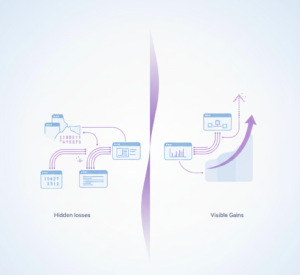
Tangleware is the tangle of disconnected tools that was supposed to make your life easier but instead turned it into a constant game of manual data transfer, duplicated efforts, and missed information. It’s the reason you’re working 60-hour weeks. It’s the reason your caregivers spend more time on screens than with clients. It’s the reason your margins are disappearing.
And you’re not alone. We analyzed 847 home care agencies across 23 states. What we found: agencies lose an average of $130,000 to $180,000 annually just to administrative overhead created by Tangleware.
This complete guide will show you exactly what Tangleware is, why it exists, the hidden cost it’s extracting from your agency, and most importantly—how to eliminate it completely.
The Definition: What is Tangleware™ Exactly?
Tangleware is a portmanteau of “tangle” and “middleware”—and it perfectly captures the chaos it creates.
At its core, Tangleware is a collection of disconnected point solutions that refuse to communicate with each other, forcing you to become the human API that manually bridges the gaps between systems.
Think about your current software stack. You might have:
- A scheduling platform that manages caregiver assignments
- A billing system that processes claims and patient payments
- An electronic visit verification (EVV) app that tracks when caregivers arrive and leave
- A documentation system where caregivers chart their visits
- A compliance tracker that monitors credentials and certifications
- An applicant tracking system (ATS) for recruiting
- A communication platform (Slack, Teams, or similar) for staff coordination
- A Google Forms or Excel spreadsheet because something always falls through the cracks
None of these systems are inherently bad. The problem is they don’t share data automatically. When a caregiver completes a visit in your EVV system, that information doesn’t flow to your billing platform. When credentials expire, your scheduling system doesn’t know, so you’re still assigning that caregiver to visits.
You have to manually move information from one system to another. You copy visit data, re-enter hours, update compliance files, and reconcile billing information—all by hand, all the time.
That’s Tangleware.
The Hidden Cost: How Tangleware™ Destroys Your Bottom Line
You probably don’t realize how much Tangleware is costing you. Most agencies don’t, until they calculate it.
Let’s break down the hidden costs:
1. Administrative Burden: 20-29% of Revenue
Industry research (Forvis Mazars, CMS cost reports, NIH studies) consistently shows that home care agencies lose 13-18% of every dollar to administrative overhead. But agencies with severe Tangleware problems often hit 20-29%.
On a $2 million revenue agency, that’s $400,000 to $580,000 annually—gone before you pay a single caregiver.
Where does it go? Most of it goes to:
- Staff time spent transferring data between systems
- Billing delays and claim denials from data gaps
- Compliance risks and audit remediation
- Caregiver onboarding and training overhead
- Turnover costs from staff burnout
2. Caregiver Turnover: $3,000-$5,000 Per Resignation
Your best caregiver quit last month. What did she say in her exit interview?
“I became a caregiver to care, not to stare at a screen all day.”
Caregivers aren’t leaving nursing because they stop caring. They’re leaving because Tangleware has made their job 40% paperwork and 60% actual care. That ratio is backwards, and it’s destroying your retention.
Each caregiver resignation costs you:
- Recruitment: $500-$1,500
- Training and onboarding: $1,200-$2,500
- Lost productivity (ramp-up time): $1,000-$2,000
- Total per resignation: $3,000-$5,000+
If your 90-day turnover rate is 40% (industry average), and you have 100 caregivers, you’re replacing 40 caregivers every quarter. That’s $480,000 annually just to turnover.
3. Billing Inefficiency: 10-15% of Revenue Delayed or Lost
Your billing system doesn’t see your documentation system. So when claims are submitted, critical information is missing. Claims get denied. Denials mean delayed revenue. Delayed revenue means cash flow problems.
Agencies with Tangleware problems experience:
- Average Days in Accounts Receivable: 60-90 days (vs. 35-45 days with integrated systems)
- Clean claim rate: 65-75% (vs. 90-95% with integrated systems)
- Lost revenue to denials: 5-10% annually
On a $2 million revenue agency, that’s $100,000-$200,000 in lost or delayed revenue annually.
4. Compliance Risk: Citation Costs, Claw-backs, and Reputation Damage
When your systems don’t talk to each other, compliance gaps hide until they become catastrophes.
A Medicaid claw-back of $50,000-$150,000 can wipe out your entire quarterly profit. A state survey citation can damage your reputation for years. And the administrative cost of fixing compliance issues after the fact? It dwarfs the cost of preventing them in the first place.
5. Growth Ceiling: Inability to Scale
As your agency grows, your administrative burden grows faster. At some point, you hit a wall: You can’t take on more clients without hiring more admin staff. Hiring more admin staff kills your margins.
Agencies with severe Tangleware problems plateau at 50-75 clients because the administrative burden becomes unsustainable.
The Signs You Have Tangleware™ in Your Agency
Do any of these sound familiar?
- Your morning email inbox has 30+ messages across three different platforms, all related to the same set of issues
- You manually re-enter data that should flow automatically between systems
- Your caregivers document in one system, but you have to manually transfer that to another system for billing
- You have a “compliance coordinator” whose entire job is chasing paperwork instead of improving care
- Your scheduling conflicts with your billing reality—the schedule says one thing, but the bills show another
- You use spreadsheets or Google Forms to track things that expensive software is supposed to track
- Your 6 AM is consumed by call-offs and last-minute schedule changes that could be automated
- Your compliance audits are stressful “surprise” exercises rather than predictable, calm reviews
- Caregivers frequently report being confused about where to document, how to clock in, or what they’re supposed to do
- Your cash flow is unpredictable because billing is 30-60 days behind reality
If you checked more than two of these boxes, you have Tangleware.
Why Traditional Integration Approaches Fail
You’ve probably already tried to “fix” Tangleware with more integrations.
You bought middleware. You added Zapier connections. You hired an IT consultant to create API bridges. And for a brief moment, things seemed better.
Then they got worse again.
Here’s why: Traditional integration is treating the symptom, not the disease.
When you bolt together eight separate systems with integrations and APIs, you’re creating a Frankenstein monster. It’s still eight systems pretending to be one. Each one is optimized for its own function. Each one has its own data model. The integrations are fragile—one update to one system breaks the entire bridge.
And integrations don’t eliminate the manual work. They just hide it in the background. You’re still managing multiple systems. You’re still dealing with data conflicts. You’re still solving problems manually.
The real solution isn’t more integrations. The real solution is one unified operating system that replaces the entire Tangleware stack.
The Three-Step System to Eliminate Tangleware™
Eliminating Tangleware isn’t a software update. It’s a fundamental shift in how your agency operates.
Step 1: Choose Unified Over Connected
Stop trying to integrate separate systems. Start operating from a unified platform.
A unified system means:
- One data model that serves all functions (scheduling, billing, compliance, documentation)
- Automatic sharing where information flows where it needs to go without manual intervention
- Zero data conflicts because there’s one source of truth, not eight competing versions
- Built-in intelligence that catches problems before they become crises
Step 2: Implement Autonomous Processes
Once you have a unified system, you can automate what should be automated.
When a caregiver clocks in:
- That visit automatically appears in your billing queue
- Your compliance dashboard is updated
- Your case manager gets relevant alerts
- The family is notified (if appropriate)
- All zero human intervention required
Autonomous processes don’t just save time. They eliminate the entire class of manual tasks that create Tangleware in the first place.
Step 3: Measure Outcomes, Not Outputs
Stop measuring whether your systems are running. Start measuring whether your agency is thriving.
Real outcomes include:
- Caregiver retention rates (not just turnover)
- Clean claim rates (not just claim volume)
- Compliance scores (not just audit readiness)
- Care quality metrics (not just documentation completeness)
- Cash flow predictability (not just revenue)
When you measure outcomes, you can quickly see what’s working and what’s not. You make decisions based on data, not gut feel.
Success Story: Heritage Home Care’s Tangleware Elimination
Heritage Home Care was drowning in Tangleware.
They had 110 caregivers, $3.2 million in revenue, and absolutely no confidence in their data. Their compliance coordinator was working 50+ hours a week just chasing paperwork. Their caregiver turnover was 52% annually. Their average days in A/R was 78 days.
When they decided to move to a unified operating system, they spent 30 days running both the old and new systems in parallel. The Parallel Promise™ gave them the confidence they needed.
Here’s what changed:
Staffing: Their recruiting coordinator went from processing 200+ applications per month (maybe 5% qualified) to using intelligent candidate matching that surfaced only qualified candidates. Time to fill went from 38 days to 14 days.
Billing: Within 60 days, their clean claim rate went from 71% to 95%. Their A/R dropped from 78 days to 32 days. That’s a $420,000 working capital improvement.
Compliance: They went from compliance emergencies to compliance confidence. Their compliance coordinator now spends 20 hours per week on proactive quality improvement instead of 50 hours on reactive paperwork chasing.
Caregivers: With less administrative burden, fewer documentation delays, and better communication, their 90-day retention went from 48% to 85%. That alone saved them over $200,000 annually in turnover costs.
Total transformation: Revenue stayed stable at $3.2M, but profit margin went from 4.8% to 12.1%. That’s $233,000 in additional profit—entirely from eliminating Tangleware.
Your Next Move: The Tangleware Audit
The first step in eliminating Tangleware is seeing it clearly.
Conduct a simple audit:
- List every software tool your agency uses (include version and cost)
- For each tool, list what data it owns (schedules, credentials, care notes, billing, etc.)
- For each piece of data, count how many times it gets manually entered or transferred
- Calculate the time cost: Hours per week × hourly rate × 52 weeks
- Add the software costs for all tools that could be replaced
- Total it up: This is your annual Tangleware tax
For most agencies, that number is shocking.
Once you see it, you’ll understand why eliminating Tangleware isn’t a nice-to-have. It’s essential to your survival.